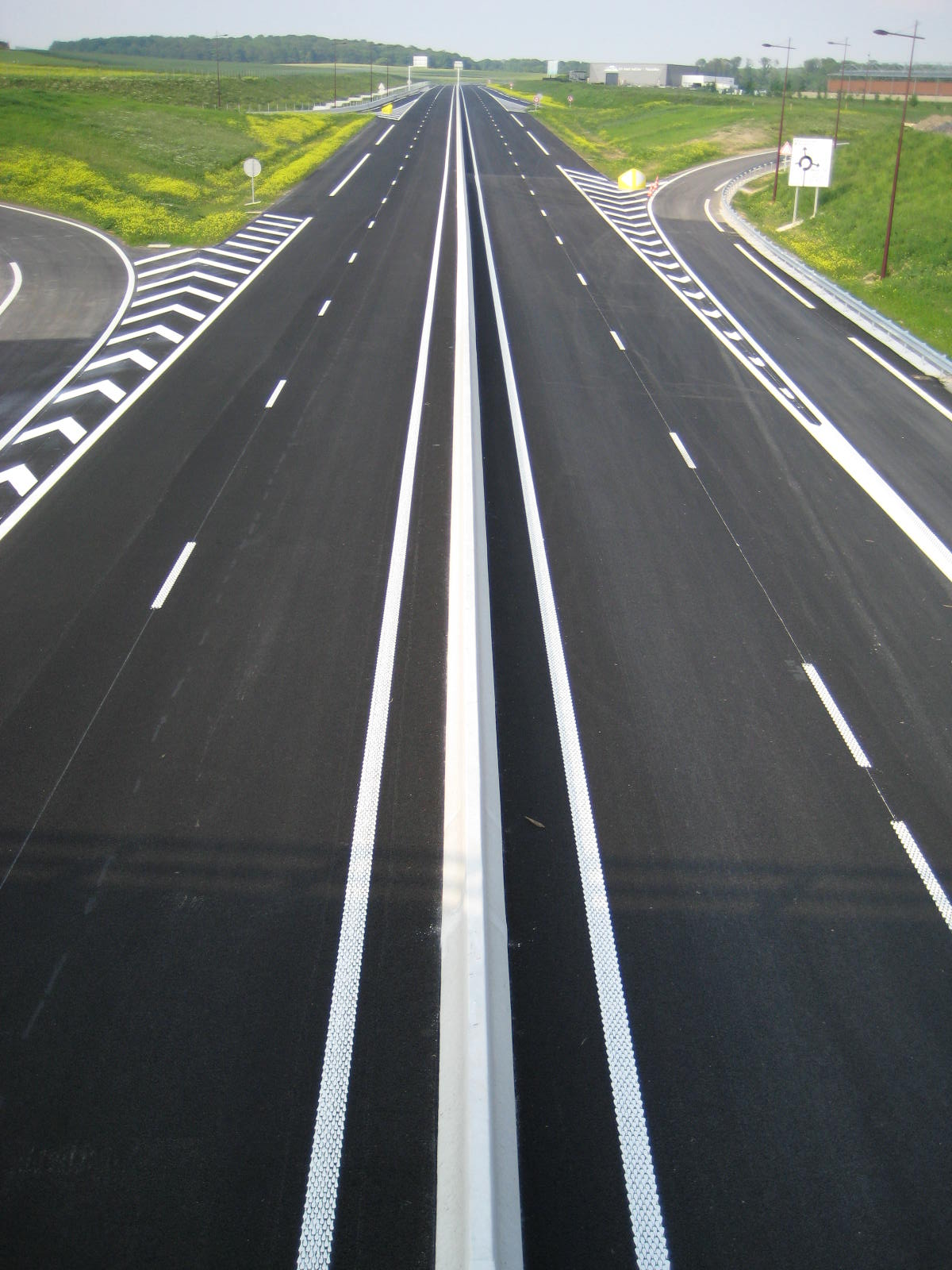
A few years ago I had a team that worked on software for this - it was far more complicated than expected. The hardware, IE: trucks with paint equipment, are also far more complicated as you've got to get the application of paint just right or else it leads to too little (and thus repeat applications) or too much (which over the miles becomes big $$$). Also, it's not always just paint - it can have reflective material and binders with various kinds of textures added as well.
edit: For what it's worth, my impression at the time is that this is an industry ripe for disruption. Every city / state / county has to deal with road striping. They do it through a combination of their own rigging and/or various firms who specialize in this stuff - both hardware and software - but where there isn't a dominate provider. It's classic B-school stuff: take a cottage industry and standardize the process, outperform your competitors because of your standardization, and become the monopoly.
I ran into this myself being involved in a highway project along the Oregon coast. There was a very fine balance of paint reflectivity, traction, and wear resilience that had to be met and it turned out it was very, very trick to hit the right spot.
E.G., the paint itself has very poor traction characteristics when wet, which it often is on the pacific coast. Adding texture coatings to it then impacts the reflectivity, but reflective additives within the texturizer cause it to wear faster..
We were only paving 4 miles, but I saw several inspectors grow a lot of gray hair over the course of a few months.
I spent some time in Germany and something that struck me was the omnipresence of the Unimog. It seemed like for every outdoor job that can exist, there is an attachment you can bolt onto the front of a unimog to do it. Utility trucks are relatively highly customized in the states compared to that.
Its a hybrid of a truck and farm tractor. The track width was standardized to the width of two rows of planted potatos. It was instrumental in the German rebuilding effort after WW2 so it sort of became a national point of pride, the vehicle that rebuilt Germany.
As to why the hybrid idea never made it to the USA is the USA did not suffer continuous allied bombings and therefor had no need to develop a multipurpose vehicle. The Unimog replaced two vehicles thus being very convenient and cost effective in post war Germany. A single vehicle could till fields, haul crops, haul building materials, and plow snow. USA had all of those things already. Why reinvent the wheel?
Monopolies are often created through innovation, either through lowering costs or increasing quality above competitors. Carnegie Steel, for example, used the Bessemer process to drastically lower the cost of steel and thus drive competitors out of business. Google used innovation to make searches much better and faster.
There are certainly other ways to create a monopoly, such as regulatory capture, illegal activities, and price dumping, but natural monopolies due to superior levels of innovation do exist. The reason we generally want to avoid monopolies isn't because of the way they are created, it's because of the damage they can cause after they are firmly established.
One of the big changes happening in the industry is increasing collection of road line quality data. Previously we'd use handheld meters to spot check pavement markers. The new state of the art is to use continuous laser scanners attached to vehicles to measure all of the pavement markers on the road. This data is used to identify what areas need to be re-striped, to see how different materials fare in different conditions over time, and to submit warranty claims when things aren't up to spec.
I'm surprised Tesla (or similar data collection fleets, like Google Street View) isn't measuring this and offering it to road authorities as a dataset. They have 1 million+ vehicles traversing roads daily, and they're already collecting labeled data (10 second video clips) for Dojo. Lane markings directly impact quality of driving assistance experience, so vehicle manufacturers have a vested interested in high quality road/lane markings.
Transit authorities care most about the quality of the data and the chain of control over the data from collection to QA and finally to delivery.
Most commercial LiDAR trucks are accurate down to millimeters in relative terms and centimeters in absolute position terms. The equipment has been certified by approved surveying bodies, and there are official records as to that specific piece of collection equipment’s accuracy and precision.
If any autonomous car company could deliver data to that standard then it would be valuable. But to my knowledge none of them can, because the accuracy of measurement systems for surveying roads at motion are so specialized and expensive.
Do you have any links on the topic you could share? Very interested in learning more! I am a bit of a precision positioning and fleet data collection wonk.
Would also be interested in some more info! @toomuchtodo I'm just breaking into the fleet data collection space - any tips on where to go to learn more?
State of the art, aye, but definitely funny hearing about the job I was at 7 years ago (where things were fully operational, not experimental) being referred to as so new!
When I was there, it was a combination of (1) downwards facing line lasers measuring distance + reflectivity, (which was viewed as a greyscale image, around 4k pixels == width of a lane iirc) and (2) forward facing cameras for tagging assets like signs, plus (3) velodyne lidars for much coarser 3D point cloud (including measuring bridge heights). The scanning worked up to a bit under 70 mph, which was impressive to me, particularly that first part of the sensor package.
Apparently here in the US they use beads of glass sprayed onto the wet paint for reflection. It kinda works; but for the longest time I wondered why the paint here is nowhere near as reflective as the kind used in Europe which has little bumps for sound but also better visibility with rain.
> The painters aim for straightness. They relish the crispness. They try to tune out impatient drivers who yell or honk or even sometimes throw things at them.
What is it about driving a car that turns people who are probably otherwise normal adults into literal babies. Who screams (honks) as loud as they can, without a care for who it might bother? Babies. Who throws things at people when they are upset? Babies.
I think the requirements to be licenced to drive should include a basic understanding of traffic dynamics. When a person gets in your way so you can't speed through the lights and you end up waiting at a red, they didn't lengthen your trip at all and are not worthy of any directed rage. You were just going to be stopped by the next light and get to your destination at around the same time. If there is roadwork or an accident, everyone is in the same boat and no single person can speed you up or slow you down.
We've all collectively just accepted to be subjected to an enormous amount of noise pollution and sometimes deadly violence on the road simply because people can't understand and/or accept the realities of how driving infrastructure works. It's kind of mind-blowing if you consider it.
I read a quote from one of the Sandy Hook parents: Anytime you put a machine between people, the person at the other end of the machine is dehumanized. I'm paraphrasing here, and they were talking about a gun, but I think it holds true for cars and computers as well.
It would be nice, but in my opinion it’s not caused by being in a car. Some people will try to take advantage of any system where they won’t feel/see negative repercussions. You can call it externalities causing global warming or you can call it my dad reusing a coupon because the cashier didn’t collect it.
We see it more in cars because of the isolation and velocitization: someone running or on a bicycle _can_ be rude too but it’s far, far less common because they feel like part of the community without the isolation of being in a sealed metal box kept multiple body-lengths from other people and there isn’t billions of dollars of design and marketing saying that it’s all about going 70mph, anyone who doesn’t go fast is a fool, and everyone else should get out of your way.
I used to car commute & now use bike/transit exclusively. I see more people being considerate, apologizing for confusion, etc. in a given day than I used to see in a year of driving in California. The reduced safety & quality of life isn’t just because cars are faster - a lot of people just seem to do the same thing internet commenters do and let distance bring out their worst sides, only they’re doing it with several tons of metal which can reach killing speed in less time than it takes to think.
>What is it about driving a car that turns people who are probably otherwise normal adults into literal babies. Who screams (honks) as loud as they can, without a care for who it might bother? Babies. Who throws things at people when they are upset? Babies.
They're not angry at the road crew. They're angry at the state police, DOT bureaucrat or whoever that decided to block off way more road than was strictly necessary and they're taking it out on the road crew. They're angry at the state for making their lives harder than strictly necessary and they're taking it out on the messenger.
>When a person gets in your way so you can't speed through the lights and you end up waiting at a red, they didn't lengthen your trip at all and are not worthy of any directed rage
If it never has positive ROI people wouldn't do it. Just because people don't share the same reading of the situation as you doesn't make them stupid. During peak hours where I live missing a light adds more than just that light to the time because you now are behind more traffic that just got onto the road. So instead of waiting two cycles to get through the next light you might wait three, and so on and so on.
>We've all collectively just accepted to be subjected to an enormous amount of noise pollution and sometimes deadly violence on the road simply because people can't understand and/or accept the realities of how driving infrastructure works.
One man's "accept the inevitable" is another man's "needlessly bend over and take the unnecessary". If people went when the light turn green, didn't stop at cloverleafs(!!), etc there's be a lot less honking.
There's a lot of roadwork on 101 in the Bay Area and so I see many different lines being painted, scraped up and moved. Recently I was curious how my new car, which has automated lane keeping, handled various situations, like:
1) no lane markers. Just lots of recently paved black asphalt across multiple lanes (seen near SF recently).
2) conflicting lane markers. the previous markers were "Scraped" physically off the road, leaving a large high contrast mark. The new markers weren't painted on well, so it was hard to tell which was the new road and the old one.
3) various ambiguous areas where lines change from one type (solid white to yellow)
The car didn't handle any of those situations well. I had a hard enough time with the first two that I'm not surprised.
My parents have vehicles with different levels of road-assist or whatever you want to call it. This is the Midwest. I don't go a day without driving through some kind of construction. It's a constant headache when I borrow a vehicle, but they don't seem to mind. I was driving along a bridge under construction a couple months ago and the damn car tried to pull me into the concrete guard separating the 2 lanes of traffic. Not very safe imo.
> The painters aim for straightness. They relish the crispness. They try to tune out impatient drivers who yell or honk or even sometimes throw things at them. But they know that unless they mess up, few will consider their work.
Ah, I know that feeling...
(And what the hell is wrong with someone that gets angry at a road crew?)
> When Garza presses a black button spraying white paint on the road, it also triggers a second gun behind the paint gun to sprinkle tiny salt-size glass beads. If the paint is too thin, beads won’t stick to it. That means the lines won’t reflect light.
I don't think they use these beads in the road paint universally. The lines here in the piedmont region of NC are virtually impossible to see at night, especially when they are wet.
> (And what the hell is wrong with someone that gets angry at a road crew?)
Seems a lot of people feel this way. Haven’t you seen those “end construction” protest signs? People seem to post them almost anywhere crews are working!
Contrast that with all the complaining about how bad the roads are. Yea, the construction is a pain, but at least I connect that with better roads in a few relatively short months.
That's the attitude that a lot of people have, which makes me wonder what other professions they have no personal experience with, yet are able to deduce the precise level of work being done by other people with a mere glance!
Every time I see the lines getting repainted I impulsively swerve over them. The reactions from the crews aren't even anger, just confused exasperation. ymmv
>(And what the hell is wrong with someone that gets angry at a road crew?)
They're not angry at the road crew. They're angry at the state police, DOT bureaucrat or whoever that decided to block off way more road than they see being strictly necessary, inconveniencing them, and they're taking it out on the road crew.
I never once considered the amount of engineering it goes into painting the lines on the street. I feel it for them, good (perfect) work goes un-noticed while bad work is obvious and criticized. Also seems like the work requires a lot of focus and constant attention. That in combination with physical labor sounds really exhaustive.
I'm always amazed at the amount of engineering that goes into, well, everything. Like how each transmission line tower is designed by someone for that specific location, even though the overall design looks the same from tower to tower. There's just so much to modern life that we take for granted these days.
Really not a fan of this slideshow style presentation - tons of great media sure, but I don't see why that couldn't be inlined or at least responsive to scrolling
> Quite the opposite. I really enjoyed the format that shows one whole slide at a time instead of seeing content progressively reveal via scrolling.
Sure, but what about content that is always visible that you scroll manually to signal your intent to read something, and then read where you stop yourself? You know, like a classic web page.
better than no bike lane at all, though. Drivers don't really respect the painted bike lanes when there are no bikes around but I notice that it does raise awareness that a bike might appear
While driving around Africa and the length of the Americas I really did see guys lying on moving flat decks using paint brushes to paint road lines. The 8 year old in me was pretty excited!
This is a really good medium for reading news.
Perhaps better if it had a reader mode button, but nonetheless I enjoyed how seamless the slides and ads slotted together.
Interesting. In this case, I think you would have been missing out. Much of the presentation is the interspersed images, and more frequently, small videos to hammer home the attention to detail required to do this well.
They really wouldn't need to spend so much on hosting fees if they were willing to do a text-only version - the main website is heavy as hell. I'm sure many people would be willing to pay for it.
Also these days I don't consume regular content from sources that do not provide an RSS feed.
When this becomes common for non-techie forums, I worry about what will happen to archive.org. I don't mind paying for news, but there really aught to be something better than what we have.